![[back]](/assets/home_24dp_E3E3E3_FILL0_wght400_GRAD0_opsz24.svg "[back]")
![[search]](/assets/search_24dp_E3E3E3_FILL0_wght400_GRAD0_opsz24.svg "[search]")
Theos and Daimones
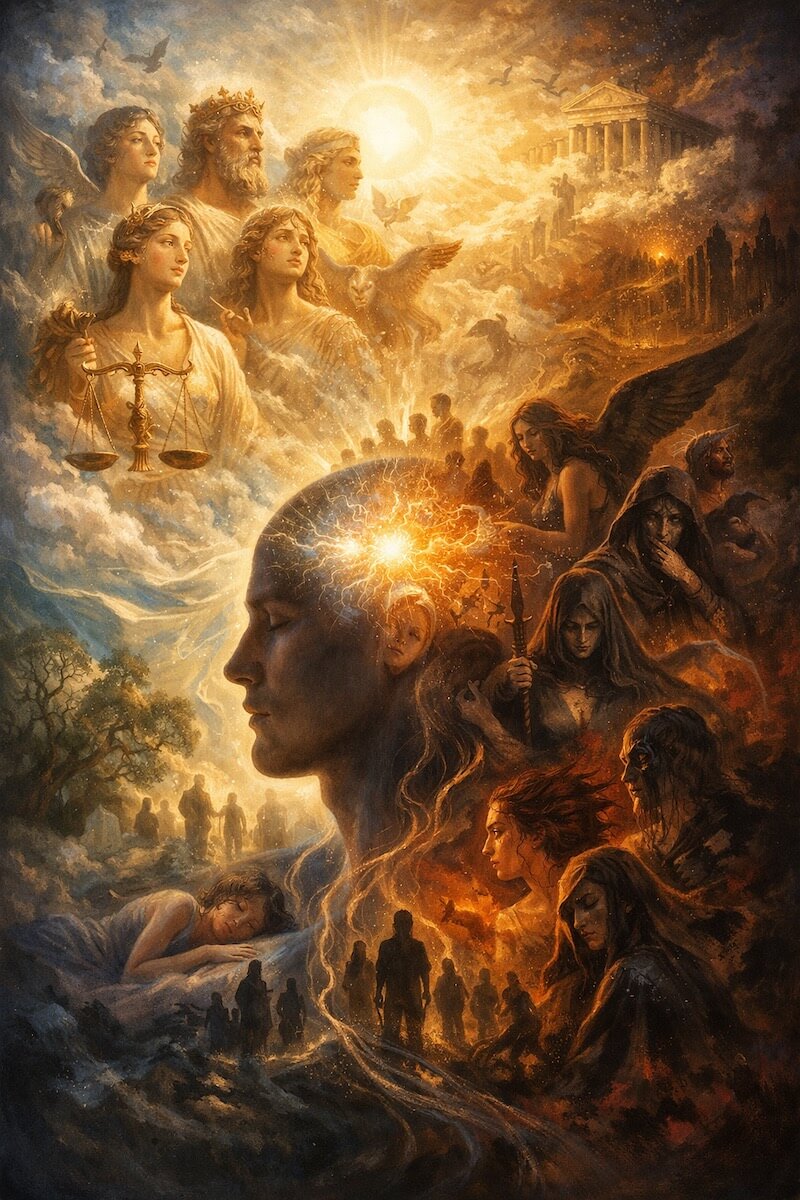
Theoi and Daimones
The Greeks gave names to the forces shaping our inner and outer cosmos
the patterns of nature: within us, between us, and around us.
Do not confuse daimones with the later reframed demons.
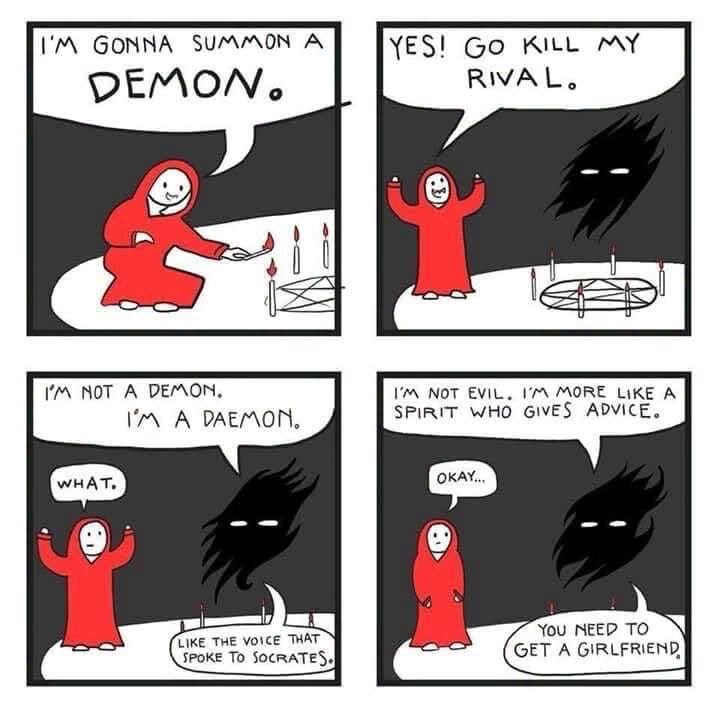
In Greek thought, θεός (theos) and δαίμων (daimōn) are not supernatural. They are aspects of mind, both internal and external, and sometimes role-titles for humans.
θεός (theos) and δαίμων (daimōn) are not strictly “species of supernatural beings,” but functional terms describing forces, agencies, or intelligences that can be perceived / personified within the inner psyche or perceived / personified within the outer social psyche.
ψυχή (psuche) = psyche, animated force of life, which is equivilent to our programming, that mind (or neurological constellation) that drives us (psuche/ψυχή later reframed / often mistranslated as = supernatural soul)
The point is that it's about naming aspects (parts/personas/archtypes) inside of you, and outside of you (nature, knowledge, justice, liberty, love), as Theos (higher divine state of mind), Daimones (lower divinity). These are named concepts/personas inside and outside of us that exist in our nature, in our Kosmos... these concepts live in our own minds and in our collective consciousness... by naming them, they may help in self analysis, discussions with others who share the vocabulary, or manifest as beings in dreams, entheogenic practice, or in transcendent types of meditation. You don't need belief for these... they exist, mentally in our collective understood consciousness (if we're all aligned)... We're just describing and naming them...
If not clear by now, these are not "real" species, these are not "real" gods/goddesses, they are mental only, they exist in our collective minds, only. They are made real, because we know them. And these real things can be organized, consulted, listened to, under the right conditions (e.g. meditation and focus, with help from entheogen, trance, music, imagery, techniques)
internal to the psyche
- theos - higher mentality aspects, anthropomorphized, ruling or governing constructively, unity mind, (maybe harmonized daimones too?)
- daimones - lower mentality aspects, anthropomorphized, of our "true self", parts of our ego that must be aligned to avoid disharmony.
externally perceived by the psyche
- theos - divine concepts anthropomorphized, like knowledge (sophia), justice (dike), liberty, truth, love (aphrodite)
- θεός Σοφία (Sophia) – the organizing intelligence of understanding; wisdom perceived as a guiding presence that orders knowledge and insight.
- θεός Δίκη (Dikē) – justice as a cosmic ordering principle; the perceived force restoring balance when actions disrupt communal harmony.
- θεός Ἐλευθερία (Eleutheria) – liberty or freedom experienced as a higher impulse toward autonomy and self-determination.
- θεός Ἀλήθεια (Alētheia) – truth or unconcealment; the force by which hidden things become revealed or recognized.
- θεός Νοῦς (Nous) – intellect or ordering mind; the universal intelligence that structures perception and rational understanding.
- θεός Λόγος (Logos) – rational structure or meaningful ordering; the intelligible pattern through which the kosmos and discourse become understandable.
- θεός Χρόνος (Chronos) – the structuring flow of time itself; the ordering framework through which events unfold and are measured.
- θεός Φύσις (Physis) – nature as a generative process; the unfolding growth and transformation visible in living systems.
- θεός Τέχνη (Technē) – craft, skill, or creative knowledge manifesting in invention, art, and constructive human activity.
- θεός Μνήμη (Mnēmē) – memory as the preserving power of experience; the continuity that links past perception to present understanding.
- θεός Χάρις (Charis) – grace, beauty, or pleasing harmony appearing in relationships, art, and social interaction.
- θεός Φιλία (Philia) – the cohesive force of friendship and social bonding; the principle that binds communities together.
- θεός Ἀρμονία (Harmonia) – harmony or proportion perceived in music, mathematics, or social order.
- θεός Εἰρήνη (Eirēnē) – peace or stable equilibrium within societies or natural systems.
- θεός Πειθώ (Peithō) – persuasion; the subtle force through which speech influences minds and decisions.
- θεός Βουλή (Boulē) – deliberative counsel; the higher faculty of planning and collective decision-making.
- θεός Μοῖρα (Moira) – the allotting order that distributes the share of events or destinies among beings; a structuring cosmic principle.
- θεός Νέμεσις (Nemesis) – the divine force restoring proportion when excess, arrogance, or injustice occurs.
- θεός Ἀνάγκη (Anankē) – necessity or inevitability governing the structure of events and constraints of reality.
- daimones
- δαίμων Ἔρως (Eros) – the impulse of attraction/desire encountered as an external force moving people toward one another; a mediating power between mortal and divine (Plato, Symposium).
- δαίμων Τύχη (Tyche) – the agency of circumstance, luck, or contingency appearing to shape events outside one’s control; the “daemon of chance.”
- δαίμων Καιρός (Kairos) – the power of the opportune moment; the felt pressure that now is the right instant to act.
- δαίμων Φήμη (Phēmē) – the circulating voice of rumor or reputation moving through a community.
- δαίμων Λοιμός (Loimos) – pestilence or epidemic experienced as an external destructive agency.
- δαίμων Ἄτη (Atē) – the force of ruinous delusion or blindness that overtakes individuals or cities.
- δαίμων Ἔρις (Eris) – the power of strife or contention that drives rivalry, competition, and conflict (Hesiod distinguishes destructive and productive forms).
- δαίμων Ἐρινύες (Erinyes) – avenging forces arising from violated order (blood-guilt, oath-breaking) that pursue offenders socially and psychologically.
- δαίμων Ὄναρ (Oneiros / dream-daemon) – the appearing dream-figure that delivers images or messages during sleep.
- ἀγαθὸς δαίμων (Agathos Daimōn) – the beneficent guiding influence associated with prosperity, protection, or right fortune.
Variants
Shift: θεός → δαίμων (in some traditions)
- θεός Σοφία (Sophia) → sometimes treated as δαίμων Σοφία in Middle-Platonic or later philosophical frameworks where abstract intelligences mediating knowledge are classed among daimones rather than full theoi.
- θεός Πειθώ (Peithō) → often treated as a daimōnic persuasive force rather than a theos in rhetorical and philosophical interpretation (though cultically she appears as a goddess with Aphrodite).
- θεός Βουλή (Boulē) → sometimes interpreted as a daimōnic faculty of deliberation rather than a theos outside civic cult contexts.
Shift: δαίμων → θεός (in cult or poetic usage)
- δαίμων Τύχη (Tyche) → widely worshipped as θεά Τύχη in Hellenistic civic cults (city patron goddess of fortune).
- δαίμων Ἔρις (Eris) → explicitly a θεά in Hesiodic genealogy (Theogony), though functionally treated as a disruptive daimonic force in philosophical readings.
- δαίμων Ἐρινύες (Erinyes) → often treated as chthonic goddesses (θεαί) rather than daimones in tragedy and cult.
- δαίμων Ὄναρ / Ὄνειροι (Oneiroi) → in epic tradition the Oneiroi are divine beings sent by Zeus, not merely daimones.
Items generally stable (rarely moved between categories)
(no meaningful classification disputes in major traditions)
- θεός: Δίκη, Ἐλευθερία, Ἀλήθεια, Νοῦς, Λόγος, Χρόνος, Φύσις, Τέχνη, Μνήμη, Χάρις, Φιλία, Ἀρμονία, Εἰρήνη, Μοῖρα, Νέμεσις, Ἀνάγκη
- δαίμων: Καιρός, Φήμη, Λοιμός, Ἄτη, ἀγαθὸς δαίμων
Schools where the shifts occur
- Hesiodic / mythic tradition – tends to treat many of your daimones (Eris, Erinyes, Oneiroi) as full theoi in genealogy.
- Classical philosophical (Plato, later Platonists) – tends to classify mediating forces as daimones, shifting some of your abstract theoi downward.
- Hellenistic civic cult practice – elevates forces like Tyche into major theoi due to worship and temples.
Compare these Related Terms
- ψυχή (psuche) = psyche, animated force of life, that which moves all life, which is equivalent to our programming (e.g. consciousness, mind, neurological constellation, self, being, etc), later reframed / often mistranslated as = soul (as a supernatural being separate from our physical shell)
- πνεῦμα (pneuma) = breath, wind, or animating current; the vital medium that carries and distributes life and sensation through the body and world. In physiological and philosophical texts it refers to the moving breath-like energy that circulates within living beings and permeates nature, enabling perception, motion, and vitality.
ψυχή (psuchē) and πνεῦμα (pneuma) are not categories of agency like θεός or δαίμων. They both describe life-force / animating principle / breath / vitality, not the named conceptual aspects or agencies within or perceived by that life-force.
See Also
- Above and Below the Line - harmonizing your personality
- Internal Family Systems - harmonizing your inner parts
- Greek Mysteries - learn about the greek mysteries
External:
- Theoi - nice site cataloging all the Theoi and Daimones